
The patellofemoral joint is the joint between the kneecap and the rest of the knee. It’s unusual in that it sits within a tendon. It plays a remarkable role in magnifying the efficiency of the quadriceps. Without it you would have to try a lot harder to straighten your leg.
Anatomy of the Patellofemoral Joint
Both bones within this joint are fairly smooth, but there are grooves on the back of the kneecap that help to keep the bone in place sliding comfortably along the rest of the knee. The back of the kneecap is covered in a smooth layer of cartilage which further improves the comfort of movement through the knee.
Positional Problems with the Patellofemoral joint
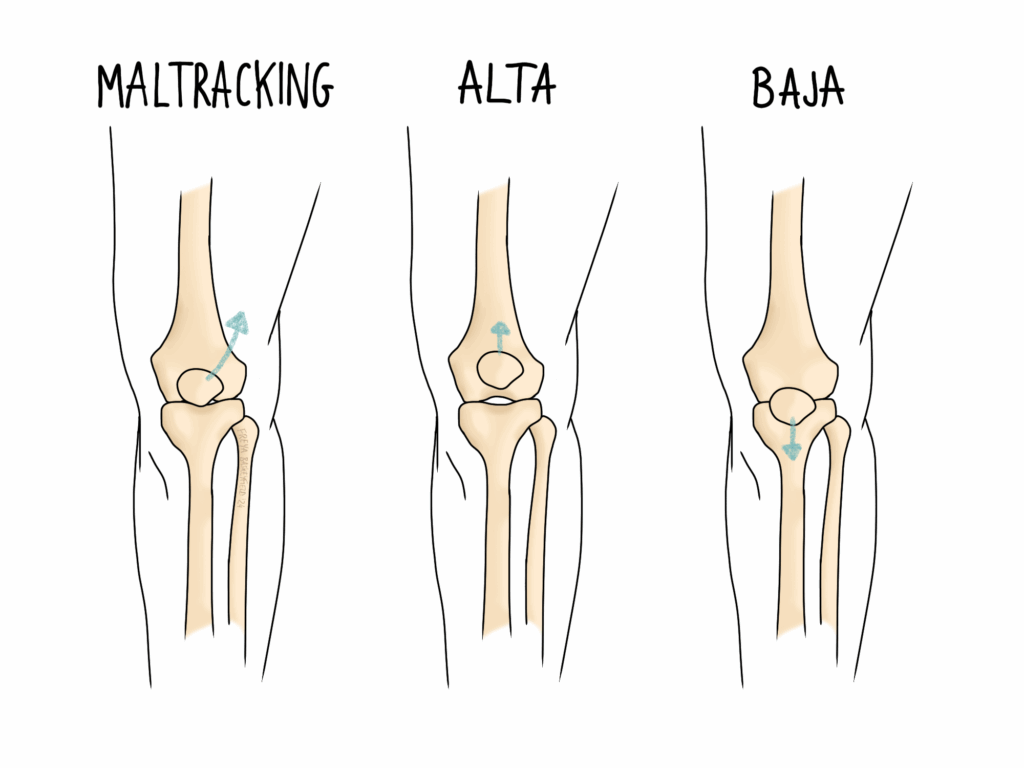
The illustration above demonstrates three positional issues with the knee.
Maltracking
When the quadriceps have an uneven balance of strength, they apply an asymmetric force on the patella. Typically, it’s the most medial muscle that is weak, and the knee cap is pulled outwards when the quadriceps engage. For most cases, this is a simple case of strengthening the weaker muscle.
Patella Alta & Baja
In these two conditions, the patella sits too high (alta) or low (baja). Alta is typically responsive to reducing quadricep tension. Baja is less common, and often follows surgery. It may require more rehabilitation than Patella Alta, but will often still respond to conservative treatments like Osteopathy.
Osteopathy for the Knee
Arthritis in the knee is one of our most commonly seen complaints in clinic. Fortunately, arthritis behind the kneecap is the most responsive to treatment. Working to reduce tension through the quadriceps and improve mobility through the knee cap can have fairly instantaneous results. You can read more about osteoarthritis in the knee here.
Maltracking issues can also be quite responsive to treatment. They usually come down to a muscle strength imbalance so between working to release tension and providing exercises to strengthen the weak muscles we can make changes pretty quickly.
Sports injuries to the patellofemoral joint often behave similarly to arthritis. Often there is a component of damage to the cartilage, and whether damage is due to injury or wear and tear, treatment is similar. Working to improve movement within the joint remove fluid buildup and balance muscle tension Will cover the majority of issues.
You may have heard of Jumper’s Knee, also known as Patellofemoral Pain Syndrome. Here, excessive pulling through the quadriceps (as per with a lot of jumping) puts too much pressure on the kneecap and causes friction, resulting in pain. If this goes on for long enough, or if the original injury is severe, there may be flakes of cartilage released from the patella that stay in the joint. These flakes can cause unpredictable patterns of clicking and locking within the knee. Fortunately they will reabsorb over time, and the more Beverley can get you moving the more we can encourage that absorption to happen quicker.
Click here to make an appointment with Beverley for your knee pain in Umm Suqeim