
What Is Upper Cross Syndrome?
Just like Lower Cross Syndrome, Upper Cross is a pattern of muscular tension and weakness. Whereas the former affects the lower back and pelvic girdle, the latter focuses around the shoulder girdle and up into the neck. Tension in one group of muscles encourages overstretching and weakness in their antagonistic pair, causing a X-shaped pattern of tension and weakness when viewed from the side.
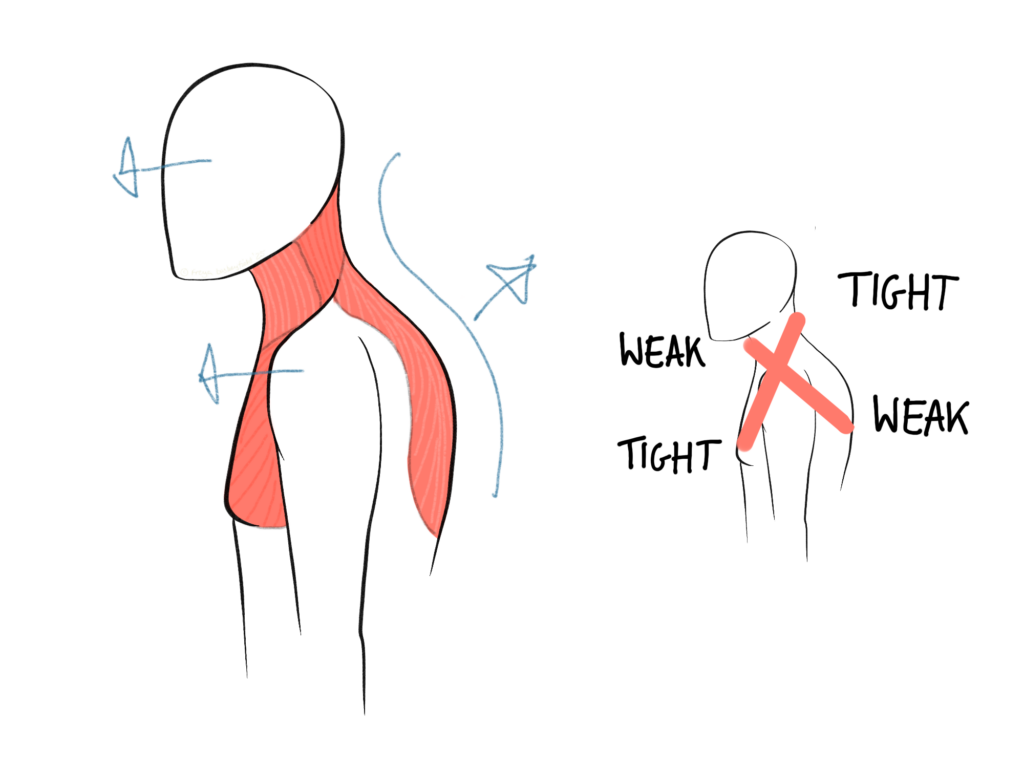
The Muscular Pattern
- Tight muscles: chest, upper back, and muscles at the back of the neck
- Weak muscles: front of the neck, muscles between the shoulder blades
This pattern causes the head to come forward, and the shoulders to round. You might notice that it’s hard to get out of a slouched-feeling posture. You might also notice restriction in your shoulder movements, and the development of headaches. If the change is significant enough to affect the vessels or nerves at the front of the shoulder, you might also develop symptoms into your arms from Thoracic Outlet Syndrome. Over time, restriction in the upper back can cause overstrain below, leading to lower back pain (which may come on as a sudden episode).
What Causes Upper Cross Syndrome?
Everyday postural demands are often at the root of the syndrome. If your work requires long periods of sitting, such as driving or working at a desk, you might find yourself in that slouched posture for hours at a time. New mothers might find that breastfeeding causes the same issue, especially if the postural changes of pregnancy already laid the foundations for a rounded posture. The good news is that it’s never too late to start acting on these compensatory patterns.
How Beverley can Help
Problems with muscular imbalances are well within your osteopath’s remit. Beverley will look for the root cause first, identifying any factors that can be mitigated to prevent further development or recurrence. Maybe your desk or car seat could be set up in a better way. She’ll also work on the tight muscles to release them, supporting this change with stretches for you to do at home. Strengthening exercises for the weakened muscles are another key part of a management plan. This doesn’t necessarily mean joining a gym, we can start with weighted objects you already have at home, or with something simple like a resistance band.
People often ask about wearable solutions to posture; osteopaths tend not to recommend these. If you can develop the weak muscles yourself, you’ll always have a built-in solution, rather than depending on something you’ve bought online. Not to mention they can be expensive and uncomfortable, potentially adding new tensions and compressions into the mix
If there are knock-on effects going on, we can work to address them too. For example, if you’ve been noticing twinges in your back, let’s make sure you’re not overworking the lower back in response to tension above. And if you have headaches, let’s work to take the edge off while restoring balance to the shoulder girdle.
Click here to make an appointment for your upper cross syndrome in Umm Suqueim