
Inside our limbs, muscles are grouped into compartments, separated by a layer of connective tissue. Alongside the muscles there are veins, arteries, and nerves. If there is swelling within a compartment, it can reach a point where the pressure cuts off blood flow and irritates the nerves. This is compartment syndrome.
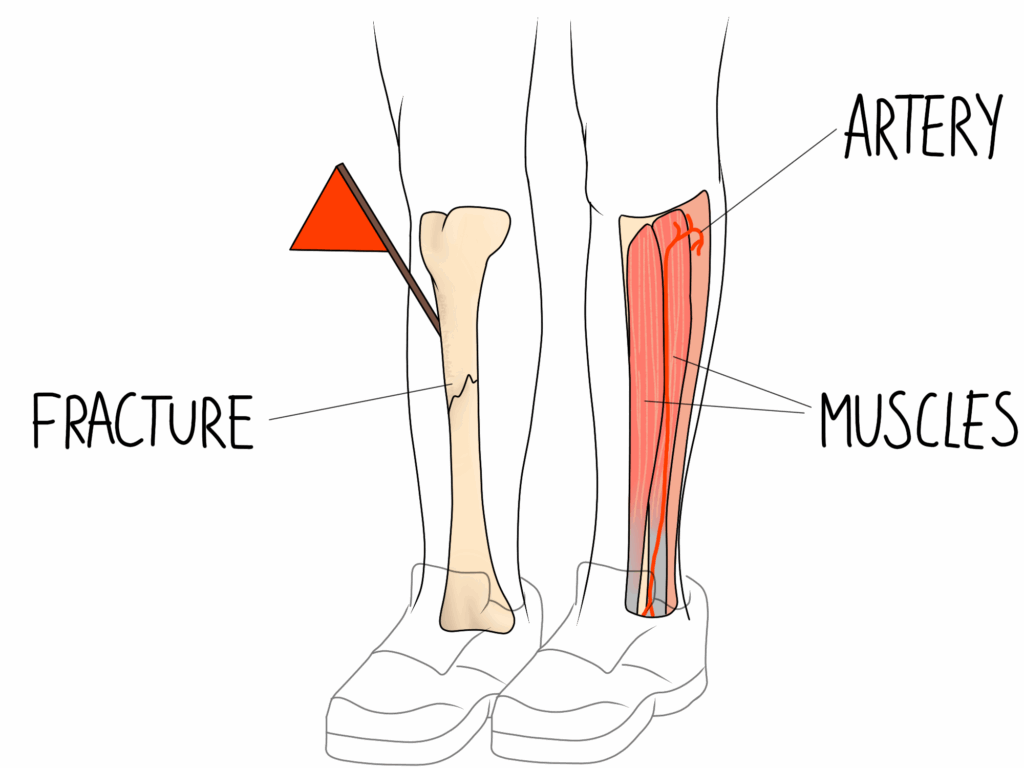
There are two types: acute and chronic. The acute form is a medical emergency, whereas the chronic form is more likely to bring you to your osteopath.
Acute Compartment Syndrome
Acute compartment syndrome usually develops after a significant injury, such as:
- a fracture or plaster cast
- a crush injury
- surgery
- severe burns
In this situation, pressure inside the compartment rises quickly. Symptoms include:
- intense, unrelenting pain regardless of heat, ice, rest, or movement
- pins and needles or numbness
- swelling and tightness in the limb
- difficulty moving the affected joint(s)
As pressure builds so quickly, it is a medical emergency. Slow treatment can permanently damage the structures within the compartment. Go straight to A&E or call 999 if you suspect you have acute compartment syndrome: osteopathy will not help you here, urgent treatment is surgical.
Chronic Compartment Syndrome
People often conflate “chronic” with “severe”. Actually, chronic means “long term”, and in this case it’s much less severe in symptoms and urgency than its acute counterpart.
The chronic form has a very different outlook. Its development is much slower, and symptoms coincide with exercise. Repetitive exercises are more likely to cause a problem, such as long distance running, rowing, and marching. Symptoms gradually reduce with rest, though some soreness may linger for a while after. The pressure increase is caused by swelling muscles with restriction around them. So chronic compartment syndrome is more likely to affect areas where there’s scar tissue, such as old injuries or surgical sites. But it can develop in any compartment.
Symptoms
As with the acute form, some swelling or a feeling of tightness is a known symptom. But this should not be agonising or unrelenting. Other symptoms are also similar, albeit much more mild than their acute counterpart. Pain is typically more of an ache, cramp, or burning sensation. And neurological symptoms are less severe too: numbness is less likely, and feelings of tingling or weakness are more expected. You may describe the sensation as more of a heaviness, and all of these would improve with rest.
Since these symptoms are more mild, they can be mistaken for other sports injuries, like cramp or shin splints. As a result, they might be brushed off or ignored for a long time. If you find you’re having a recurrent discomfort that doesn’t improve with your current stretches or exercises, make an appointment with Beverley below to see if there’s more to it than meets the eye.
Managing Chronic Compartment Syndrome
The factors specific to your case will dictate the best management plan for you. If the affected area has inflexibility due to scar tissue,
Biomechanics can also be a factor. Are there changes you can make to your exercise routine? These might include:
- altering training frequency or duration
- looking into orthotics or different footwear
- finding areas of the body that are underworking and asking more of the symptomatic area: osteopathy can help identify and manage these
- improving strength or flexibility
If any of the above points resonate with you, you can book an appointment with Beverley below.
Book an osteopathy appointment with Beverley in Umm Suqueim here for your pain