
Bunions are often dismissed as “just a bump”, but they indicate that the mechanics of the foot have changed. The technical term is “hallux valgus”, which refers to the angle of the big toe bones.
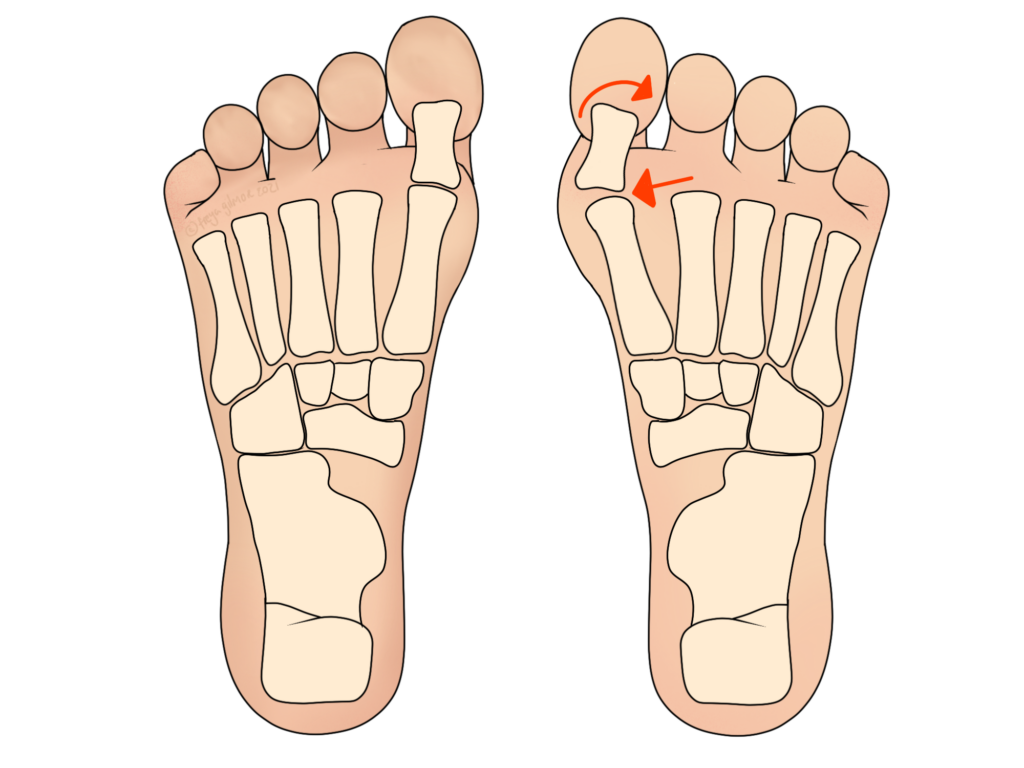
Bunions involve a deviation of the big toe towards the second toe, with a corresponding prominence on the inner edge of the foot. Beverley regularly sees bunions as part of a wider mechanical picture rather than an isolated problem.
Bunion Risk Factors
Some risk factors for bunions are inherited. Foot shape, joint laxity, and the way the bones of the forefoot are aligned can all predispose someone to developing a bunion. A family history often increases the likelihood.
However, there are also modifiable factors. Footwear that is narrow at the toes, has a raised heel, or lacks adequate support can increase stress through the big toe joint. Over time, this alters load distribution and encourages the joint to misalign.
Muscle imbalance within the foot and lower limb also plays a role. When certain muscles dominate and others underperform, the big toe is pulled laterally during walking. You can expect Beverley to look at the leg and beyond during your assessment.
Links With Other Conditions
Bunions rarely exist in isolation. Altered mechanics at the big toe can affect how forces are transmitted through the foot, increasing strain elsewhere. Beverley often sees bunions alongside:
- Osteoarthritis of the big toe or midfoot
- Metatarsalgia (pain in the ball of the foot)
- Plantar fasciitis
- Knee or hip symptoms linked to altered gait
In particular, reduced movement at the big toe joint is associated with early osteoarthritic change. When the joint cannot move efficiently, other structures compensate.
General Advice for Managing Bunions
While osteopathy cannot reverse a bony deformity, Beverley focuses on reducing symptoms and slowing progression. General advice may include:
- Choosing footwear with a wider toe box
- Reducing unnecessary pressure on the forefoot, including exercises to bring your centre of gravity back
- Supporting overall foot mobility
Orthotics may be appropriate for some people, but they work best when combined with an understanding of the whole movement pattern.
Tailored Considerations in Clinic
In clinic, Beverley looks beyond the bunion itself. She assesses ankle mobility, calf function, knee alignment, and hip control. Subtle restrictions higher up the chain can influence loading on the foot.
Hands-on treatment aims to improve joint mobility, reduce soft tissue tension, and support more efficient walking mechanics. Combined with personalised advice, this approach helps many people stay active and comfortable, even with established bunions.
Click here to make an appointment for your aches and pains in Uum Suqueim